
Why Illustration Is More Than Just Drawing
- Emily Palmer

- Feb 21
- 2 min read

There’s a quiet misconception about illustration — that it’s simply about drawing well.
But illustration isn’t just about rendering beautiful lines or mastering anatomy. It’s about translating ideas into images. It’s visual problem-solving. It’s storytelling without relying on paragraphs. It’s emotion distilled into shape, colour, and composition.
As illustrators, we don’t just draw what we see. We draw what something means.

The Invisible Work Behind Every Image
When people look at an illustration, they see the final piece. What they don’t see:
The dozens of thumbnail sketches.
The discarded colour palettes.
The moments of doubt.
The research rabbit holes.
The client revisions.
The emotional labor of staying creatively open.
Illustration is often mistaken for talent alone. In reality, it’s discipline, iteration, and constant refinement.
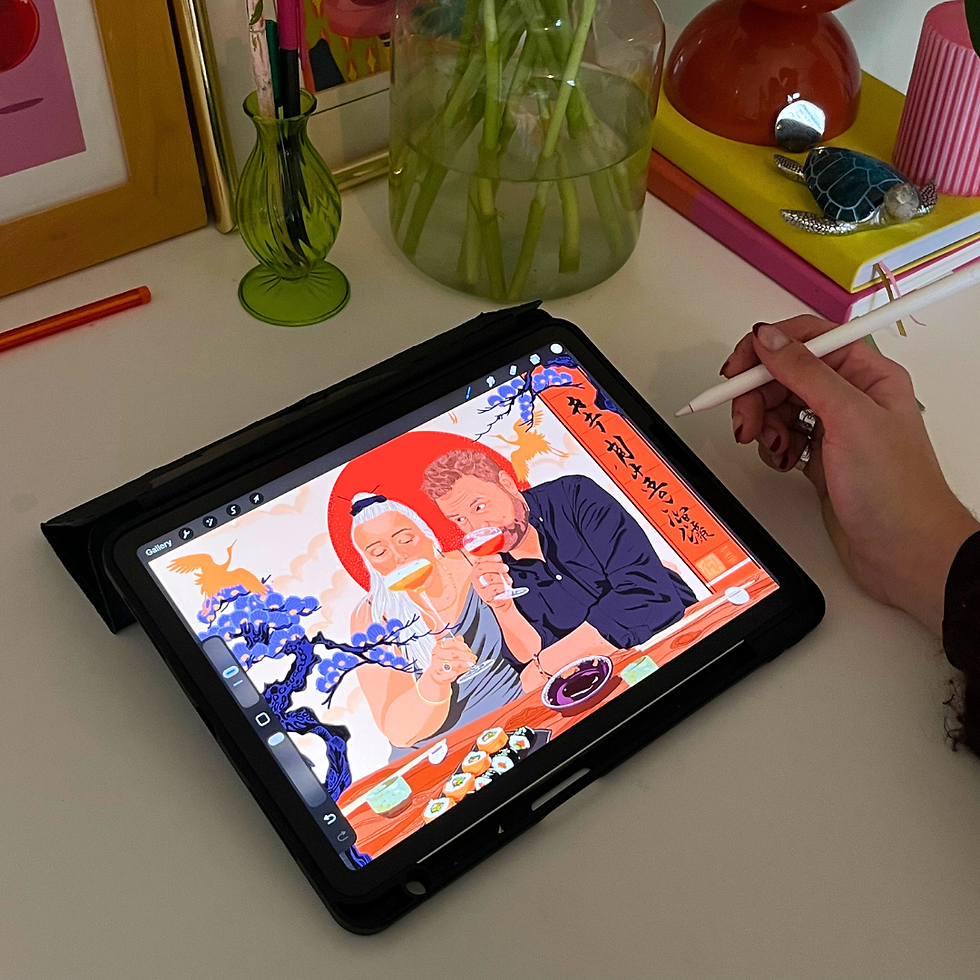
Whether you work digitally in tools like Adobe Illustrator and Procreate, or traditionally with ink and watercolour, the core of illustration remains the same: communication.

Your Style Is a Byproduct — Not a Goal
Many illustrators obsess over “finding their style.” But style isn’t something you hunt down. It’s something that forms naturally over time.
Your style is:
The shortcuts you prefer.
The shapes you default to.
The colours you feel emotionally connected to.
The stories you gravitate toward.
It emerges from repetition and authenticity. Trying to force a style often leads to creative paralysis. Focusing on clarity and curiosity leads to growth.
Illustration in the Age of Algorithms
Today, illustrators are navigating a landscape shaped by social media metrics, rapid trends, and AI-generated imagery.
Platforms reward speed. Algorithms reward consistency. But illustration rewards depth.
The question isn’t: How do I keep up?
The better question is: How do I stay intentional?
Your value as an illustrator isn’t just the final image — it’s your perspective, your lived experience, your decision-making process. No algorithm can replicate that.

Building a Sustainable Creative Practice
Burnout is common in creative fields. Deadlines, self-comparison, and financial uncertainty can drain even the most passionate illustrator.
Some reminders:
You don’t have to post everything you create.
Not every sketch needs to become content.
Rest is part of the creative cycle.
Personal work fuels professional growth.
A sustainable practice isn’t built on constant output — it’s built on rhythm.
Why Your Work Matters
Illustration shapes culture in subtle ways. It appears in books, packaging, branding, editorial spreads, children’s stories, album covers, and campaigns.
Illustrators influence how people:
Understand ideas.
Feel about brands.
Connect to narratives.
Experience information.
You are not “just drawing.”You are shaping perception.
Emily
Find me on social media:


Comments